

If there’s one group of expressions in English that can change meaning faster than British weather, it’s the phrasal verbs with LOOK. Add a tiny preposition and suddenly you’re no longer “looking” — you’re investigating, caring for someone, ignoring someone, or even anticipating the future with excitement.
Let’s break down the most useful phrasal verbs with LOOK, with plenty of natural examples you can steal for your speaking and writing.
PS: At the end of this article, you’ll find a short interactive quiz to test how well you know all the “look” phrasal verbs — so stick around! You can practise all of these with my Quizlet set.
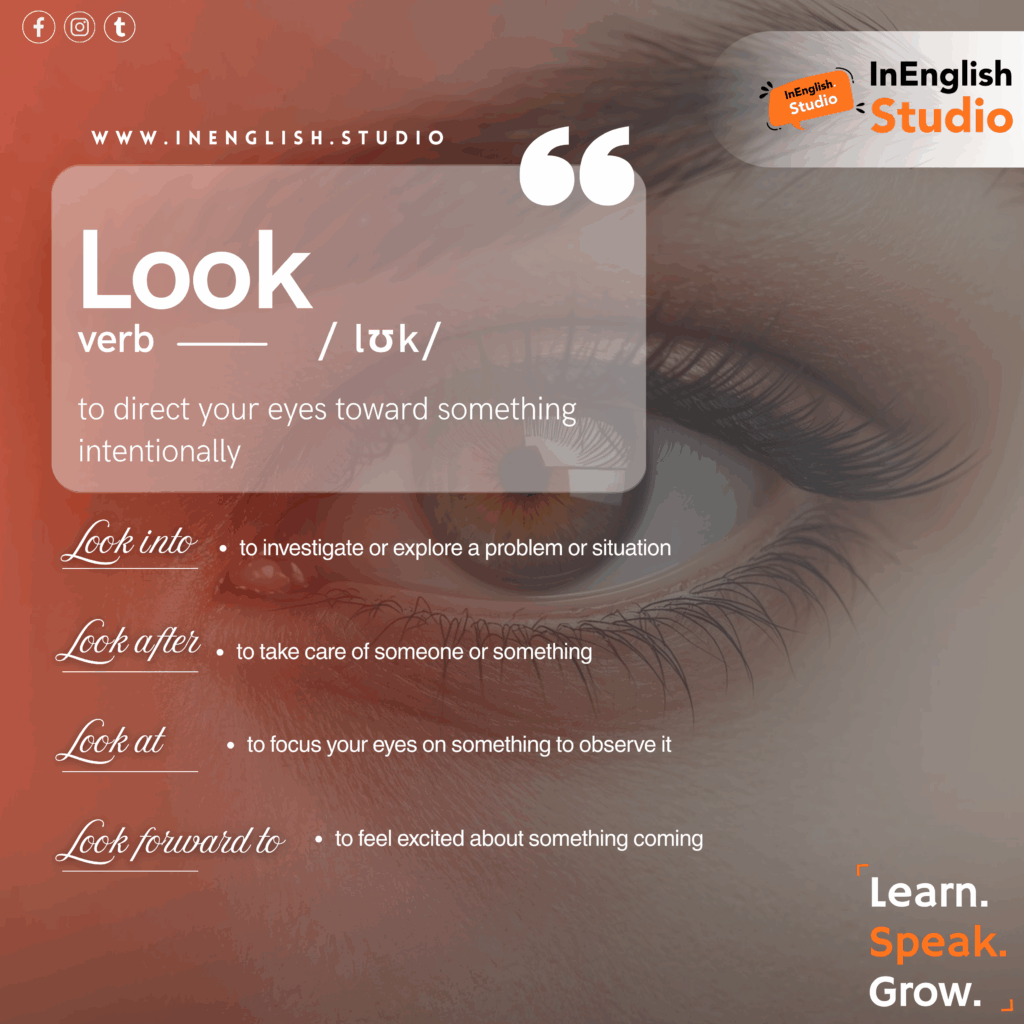
🕵️♂️ 1. LOOK INTO — investigate, explore
Use it when you want to say you’ll check something carefully.
Examples:
- The manager promised to look into the complaint as soon as possible.
- I’ll look into flights to Thailand this weekend — maybe we’ll finally book something.
- Scientists are looking into new ways to reduce plastic waste.
Perfect for work emails, problem-solving, and showing you actually know how to use phrasal verbs with “look” confidently in real life.
👀 2. LOOK AT — examine, consider
Basic, but powerful. It’s often used metaphorically.
Examples:
- Let’s look at the numbers again — something doesn’t add up.
- You need to look at this situation from a different perspective.
- We looked at three apartments before choosing the final one.
👨👧 3. LOOK AFTER — take care of
Talking about kids, pets, plants or even a book club you’re running? This one’s essential.
Examples:
- Can you look after my cat while I’m away? He’s demanding but adorable.
- Teachers look after more than just academics — they shape confidence too.
- Who’s looking after the club’s social media? The posts look great.
🔎 4. LOOK FOR — search, try to find
The everyday classic.
Examples:
- I’m looking for a quiet beach, nothing commercial.
- She’s looking for a new job in marketing.
- We’ve been looking for that document all morning.
🎉 5. LOOK FORWARD TO — be excited about something
Extremely common in formal and informal English. Always followed by -ing or a noun.
Examples:
- I’m looking forward to the weekend — finally some rest.
- We look forward to working with you in the future.
- She’s really looking forward to her trip to Madagascar.
😤6. LOOK DOWN ON — consider yourself better than someone
A bit toxic, but useful.
Examples:
- Some people look down on small sport clubs, but they have no idea how much work goes into them.
- He looks down on others just because he earns more — annoying.
🙌 7. LOOK UP TO — admire, respect
The nice version.
Examples:
- Many young players look up to successful athletes.
- I’ve always looked up to my coach — her advice has shaped the way I work and learn.
📘🔍 8. LOOK UP — search for information
Not the same as “look up to.” This one is practical and simple.
Examples:
- I had to look up the meaning of “compliance” again — it never sticks.
- You can look up the address online.
⚠️👀9. LOOK OUT — be careful, watch for danger
Often used as a warning. (You’ll also hear “watch out!” in the same meaning — both expressions are correct and used in everyday English.)
Examples:
- Look out! The ball’s coming straight at you!
- When you drive at night, look out for deer on the road.
👀➡️10. LOOK OUT FOR — pay attention to something or someone
Less dramatic than “look out,” more about being observant.
Examples:
- Look out for good flight deals — prices sometimes drop at midnight.
- I always look out for my teammates on court.
🙈 11. LOOK AWAY — avoid looking
Useful for emotional or uncomfortable situations.
Examples:
- She looked away when she realized she was wrong.
- I can’t look away — this series is too intense.
👣 12. LOOK AROUND — explore a place
Great for travel conversations.
Examples:
- We spent the afternoon looking around Hallstatt — magical.
- Let’s look around before we choose a restaurant.
🕰️ 13. LOOK BACK ON — reflect, remember
Perfect for stories or life lessons.
Examples:
- When I look back on my first year of running the company, I see how much we’ve grown.
- People often look back on their school days with nostalgia.
⭐ Quick Summary:
| look into | investigate |
| look at | examine |
| look after | take care of |
| look for | search |
| look forward to | anticipate |
| look down on | feel superior |
| look up to | admire |
| look up | check information |
| look out | be careful |
| look out for | watch for |
| look away | avoid looking |
| look around | explore |
| look back on | remember |
Now that you’ve explored how flexible and expressive look can be, it’s time to put your skills to the test. I’ve prepared a short interactive quiz where you can check how well you understand these phrasal verbs — you’ll find the link right below this post.
Phrasal verbs with look are like a language Swiss-army knife: once you start using them naturally, your English instantly sounds more confident and less textbook-like. Try choosing three of them and slipping them into your emails, conversations, or notes today. You’ll be surprised how quickly they become second nature.
And if you’d like a follow-up post with get, take, or make, let me know — I’ll happily create the next part of this series.
Link to the quiz: https://forms.gle/iueYALrp1ct3TSA18
Comments
Thanks for sharing your thoughts. Very insightful and thought-provoking.